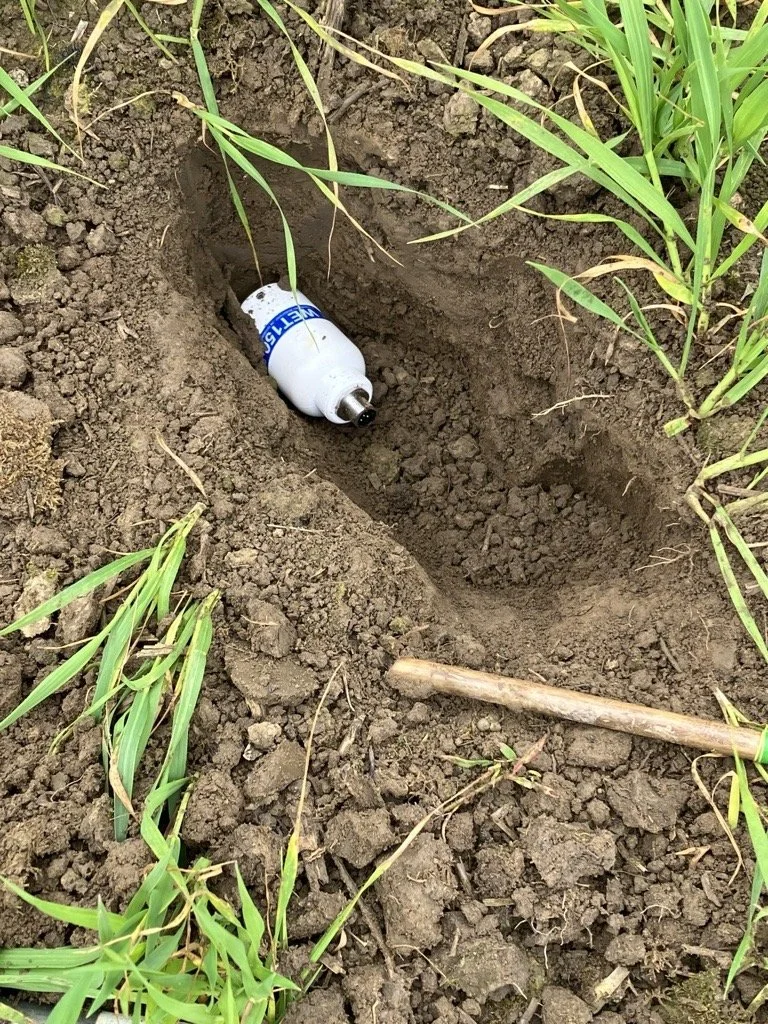
New devices were installed at Palace Leas to enable remote soil monitoring.
In October 2025, ten remote soil-monitoring devices were deployed across two treatments at Newcastle University’s Palace Leas Meadow Hay Plots long-term experiment (Newcastle University Farms, Cockle Park). The devices were installed across two of the 14 treatments to accompany a PhD project led by Will Dawson from the School of Natural and Environmental Sciences who is testing a validating eco-acoustic technologies for soil biomonitoring. Additional sensors are also deployed across agroforestry, cultivation and hydrologically isolated plots across the farm.
As part of the Northeast 5G Innovation Regions (NE5GIR) Project, funded by the UK Department for Science, Innovation and Technology (DSIT), Newcastle University has been leading the AgriTech work package. The university is demonstrating two advanced digital agriculture use cases: remote soil monitoring and methane monitoring.
A LoRaWAN (Long Range Wide Area Network)—a low-power, long-range wireless communication network designed for transmitting small amounts of data from distributed sensors—has been installed at Cockle Park to support these deployments. Using this network, devices designed by Enable IOT have been tested and deployed by the Newcastle University 5GIR team.
Each device connects a Delta-T WET150 soil probe to a custom transmitter unit, which sends soil data through the LoRaWAN gateway to cloud infrastructure, and finally into a real-time dashboard. The probes measure soil temperature, soil moisture, and soil electrical conductivity. These core metrics are being used to explore the potential for predicting broader soil characteristics, including organic matter, NPK levels, trace elements, and soil organic carbon.
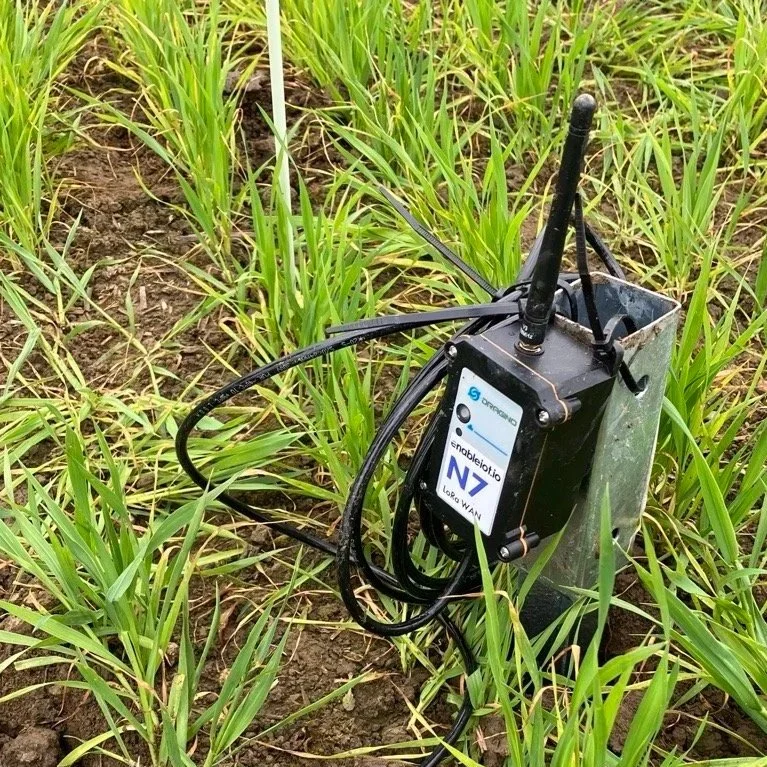
ABOVE GROUND PROBE
At Palace Leas, the sensors transmit data every 30 minutes, 24/7, year-round. Currently supporting wider postgraduate research, the system provides valuable continuous metadata to strengthen the research findings. Following completion of the PhD study, the probes will be redistributed across all Palace Leas treatments, enhancing the long-term dataset of this historic experiment and adding a new digital dimension to its ongoing scientific value.
