
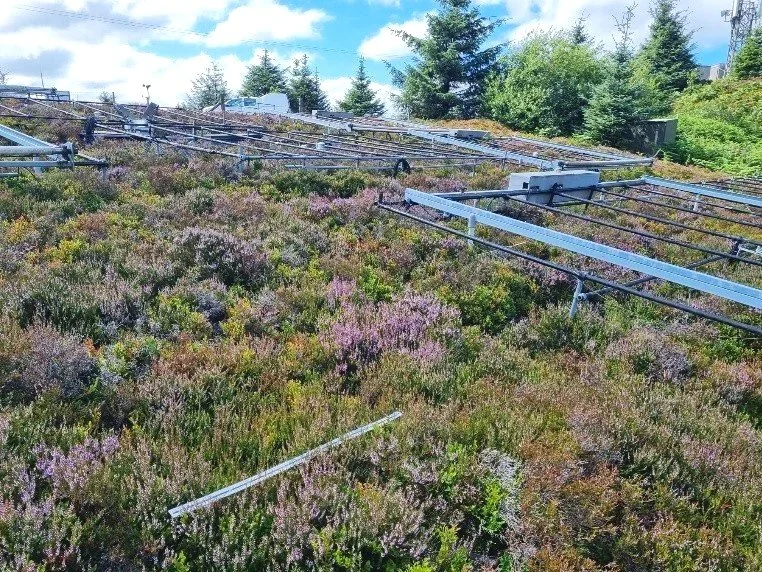
Recent results from the Clocaenog long-term experiment in Wales shows that drought frequency affects carbon sequestration more than the duration of the drought.
A recent study used data from the Clocaenog long‑term Climate Change Experiment in North Wales (UK) to inform a modelling study investigating how repeated droughts alter soil carbon dynamics in an organo-mineral soil.
Nine years of in-situ field measurements of soil CO₂ fluxes, moisture, temperature and environmental data were used to calibrate the ECOSSE biogeochemical model enabling simulations of decades‑long drought cycles and the ability to track their effects on four key soil organic carbon pools: decomposable and resistant plant material, microbial biomass, and humified organic matter.
In the ECOSSE model, four drought scenarios were imposed—lasting 12, 24, 48, or 96 years. Each was followed by an equivalent recovery period. This design allowed the UKCEH team to test whether soils could return to carbon baseline states when exposed to increasingly intermittent drought events.
The results revealed three consistent ways in which repeated droughts drive soils towards changing the behaviour of soil carbon pools:
1. Recurring drought destabilised carbon pools: shorter cycles reduced microbial biomass and humus, while prolonged drought depleted the deeper, more resistant carbon stores, limiting recovery even after rewetting.
2. Carbon sequestration efficiency shifted with drought frequency—moderate cycles supported efficiency, but long droughts sharply suppressed it.
3. Stabilisation efficiency declined across scenarios, showing that soils gradually lost their ability to convert microbial carbon into stable humus, echoing the risk of self‑reinforcing carbon loss seen in vulnerable peatlands.
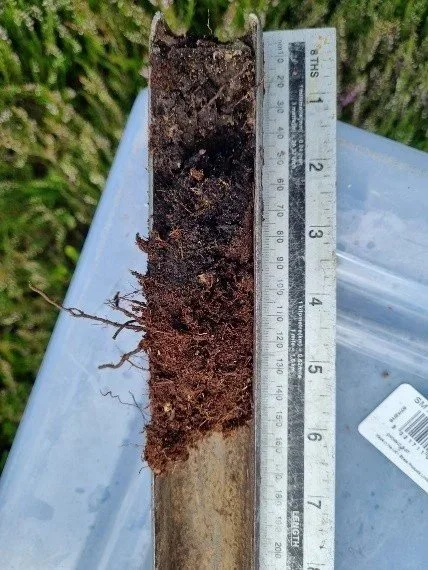
a soil core taken at the site shows the organic and mineral layers of the soil.Photo credit: Jade hatton, UKCEH
